
Participation makes business sense
Periodic review of sustainability tools helps ensure they remain effective, practical and credible. For many businesses operating in this area, the review process is not just a routine task. Updates to the Coffee Sustainability Reference Code and Equivalence Mechanism may have important operational implications, influencing how coffee sustainability is defined, assessed, and implemented across the sector for years to come. For stakeholders involved in sustainability, participating in the update process is crucial.
GCP’s public consultation, which runs until 19 June 2026, is the chance for stakeholders to voice their opinions before the tools are officially revised. Participants from around the world are encouraged to share their unique insights and identify opportunities for improvement. The feedback collected will inform the revision process and help ensure GCP’s sustainability tools stay relevant and practical for the coffee sector.
The tools in a nutshell
If your company sources, trades, certifies, or sells coffee, two tools may influence how you do it: the Coffee Sustainability Reference Code and the Equivalence Mechanism. The Coffee SR Code establishes a common baseline for sustainable coffee production across the sector. The Equivalence Mechanism determines which certification schemes are recognized as aligned with that baseline. This can influence how sustainability claims are supported, how supply chain due diligence is demonstrated, and how efficiently companies can work across multiple sourcing programs.
Together, the tools create a common language and framework for understanding, measuring and advancing coffee sustainability on a larger scale.
Why this matters to your business
The proposed updates introduce several changes that stakeholders may wish to review closely. The Coffee SR Code is being strengthened with a greater emphasis on continuous improvement and a clearer risk-based, context-driven framework. This framework is designed to adapt to various production environments your supply chain likely spans. The Equivalence Mechanism is being updated to place greater emphasis on stronger governance, better transparency and data integrity. It is shifting from simple compliance to a greater focus on real due diligence considerations.
These changes can directly affect operations. The proposed updates aim to ensure the tools are clearer, more credible, and better aligned with current regulatory and market requirements, including supply chain due diligence requirements. The updates will help companies demonstrate responsible sourcing practices, reduce duplication across sustainability certification programs, and improve the consistency of sustainability reporting.
Participating in the consultation gives your business an opportunity to help ensure that the updated tools reflect real-world implementation realities and support effective sustainability outcomes. Companies and organisations that give feedback can help identify opportunities, challenges, and unintended consequences before the tools are finalised.
What the process looks like
GCP has made it easy to participate. A short guiding video and orientation slides explain the proposed changes and how you can get involved. Two surveys are available: a 25-question main survey for high-level and substantive feedback (available in English, Spanish, Portuguese, Bahasa Indonesia, and Vietnamese), and a more detailed technical survey for those who want to engage requirement by requirement. Responses will be reported in an aggregated, anonymised form. A summary of results will be published on the GCP website in July 2026.
The main survey takes less than an hour to complete. The consultation is designed to give stakeholders the opportunity to provide practical implementation experience and perspectives before the review process is finalized.
The consultation period is now closed. Thank you to all who participated!
Lend your voice
GET STARTED!
Step 1:
Watch this Video
This short video covers the review process and content, as well as how to navigate the consultation toolkit and survey.
Step 2:
Review the Slides
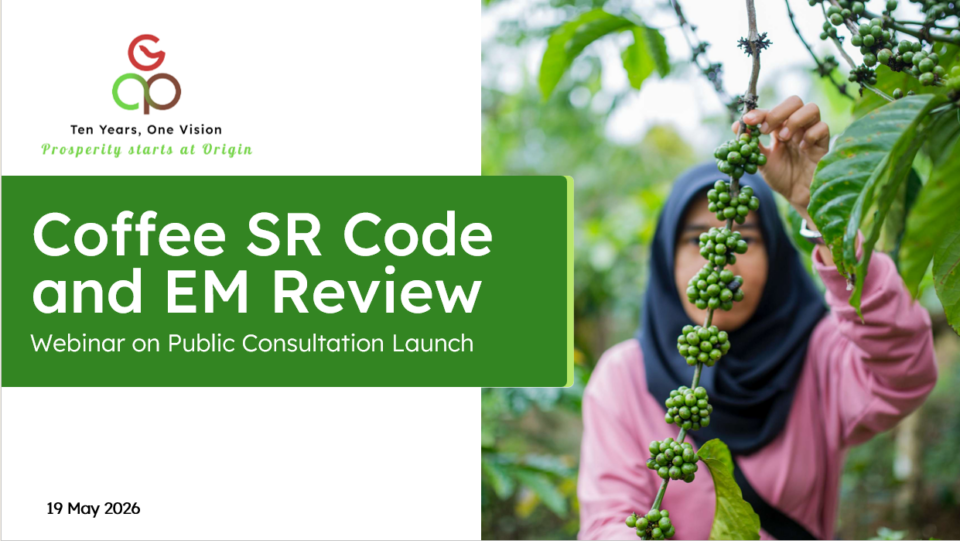
Keep scrolling to find these guiding slides available in Spanish, Portuguese, Bahasa Indonesia and Vietnamese
Step 3:
Summary of Proposed Changes

Read through the summary of proposed changes. Also available in Spanish, Portuguese, Bahasa Indonesia and Vietnamese
Step 4:
Consultation Draft
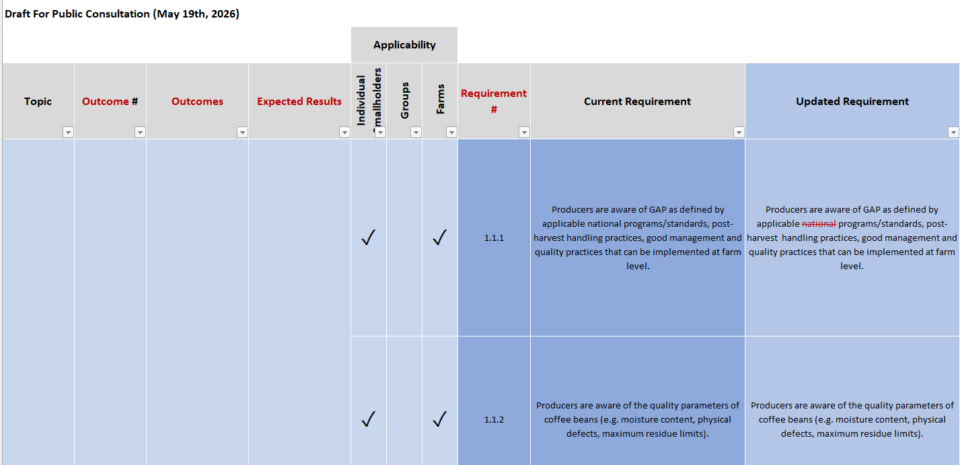
Review the consultation draft with all requirements and proposed updates. This document is only available in English.
TAKE THE SURVEYS
You can provide your input through two surveys:
- The main survey is available in English, Spanish, Portuguese, Bahasa Indonesian and Vietnamese (below)
- The technical survey is available in English
The Main Survey consists of 25 required questions covering high-level feedback and key substantive changes. A separate survey is also available for stakeholders wishing to provide more detailed technical input on individual requirements.
Your responses will be saved as you progress while the survey window remains open. You can navigate between sections to review or edit your answers before submitting. Please note that if you close or refresh the survey window before submission, your progress may be lost. After submitting the survey, you will still be able to edit your responses.
Responses collected during this process are confidential, and any reporting of results will be anonymized and presented in an aggregated manner, without identifying individual respondents. A summary of the consultation results will be developed and posted on the GCP website in the second half of July.
Main Survey
Provide high-level and key substantive changes feedback. Available in: English, Spanish, Portuguese, Bahasa Indonesia and Vietnamese.
Technical Survey
Provide detailed, requirement-specific feedback on the proposed updates to the Coffee Sustainability Reference Code and the Equivalence Mechanism Operational Criteria.
