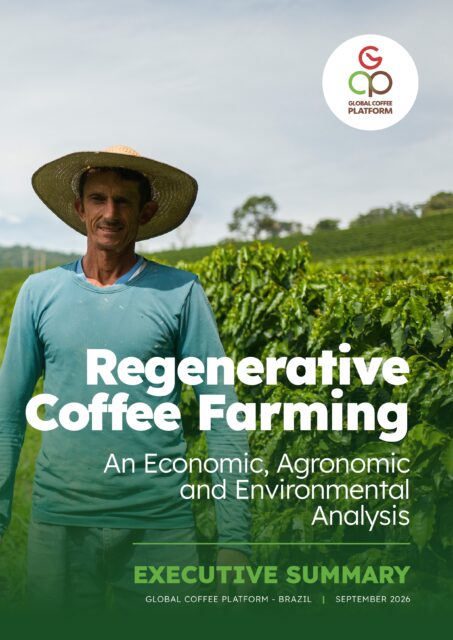
GCP Brazil, part of the Global Coffee Platform (GCP) network of Country Platforms, has published Regenerative Coffee Farming: An Economic, Agronomic and Environmental Analysis. The study examines seven coffee farms in Minas Gerais with markedly different production realities, finding that regenerative management was compatible with economically competitive production in every case. These ranged from family farms to business operations, flat and mountainous land, mechanized and non-mechanized systems, and irrigated and rainfed production.
The transition to more resilient coffee systems has become a priority for the sustainability of the global coffee supply chain. In Brazil, extreme weather events – prolonged droughts, intense, concentrated rainfall, temperature swings and hail – are among the main challenges for coffee producers. Regenerative coffee farming is increasingly recognized as a promising approach to strengthening resilience and mitigating climate change while improving natural resources.
Despite growing interest in this approach, evidence of its economic, agronomic and environmental performance under different production conditions remains limited. This study addresses that gap by examining seven Arabica farms in the Sul de Minas and Cerrado Mineiro regions, each at a different stage of regenerative agricultural practices adoption, to understand how the transition performs under real and diverse conditions within one origin.
The study was led by GCP Brazil as an extension of the collective work that produced the guide 7 Elements for Implementing Regenerative Coffee Farming – a technically robust framework for regenerative coffee production in Brazil, which aligns the sector on key outcomes, practices and corresponding indicators. Structured around seven core elements, the framework is grounded in a shared, science-based understanding and has been validated by stakeholders from the public and private sectors, NGOs, cooperatives and academia.
“This study confirms that the pathway to regenerative coffee farming has to be context-specific – there is no single way forward,” said Pedro Ronca, GCP Brazil Program Director. “What we found across all seven farms is that different combinations of regenerative practices can deliver competitive production systems, provided they are adapted to the conditions of each farm, implemented consistently and supported by technical guidance.”
“Generating this kind of evidence collectively and pre-competitively is what will allow the whole sector to invest with confidence,” said Annette Pensel, GCP Executive Director. “Data from real farms in real conditions is what turns intent into targeted investment to support producers through the transition.”
Key evidence from the study
- Economic competitiveness. Every farm recorded operating costs below the CONAB (Brazil’s National Supply Company, March 2025) reference average for Minas Gerais of R$ 768.80 per 60-kg bag, regardless of production profile, while average productivity reached 45 60-kg bags per hectare, exceeding the CONAB national reference average in 2025.
- Agronomic resilience. Surface soils were generally in favorable fertility condition, but limitations between 20 and 80 cm still restrict root development, making the building of soil health at depth the largest opportunity to strengthen climate resilience.
- Environmental performance. The farms removed considerably more carbon than they emitted, with an average net balance of −77.46 tCO₂e/ha. Emissions averaged 0.95 tCO₂e per tonne of coffee cherries produced, indicating a relatively favorable balance between productivity and climate impact.
What comes next
The study provides an evidence base to support producers, rural extension and technical assistance services, cooperatives, and traders in designing sustainability programs, strategies, investments and incentive mechanisms better aligned with different coffee production realities. While the findings are based on a limited sample and should not be generalized at regional or national level, they offer important insights into the transition to regenerative coffee farming. Future work is intended to continue assessing the outcomes of regenerative coffee farming, helping validate transition pathways and refine the 7 Elements for Implementing Regenerative Coffee Farming framework.
Scaling regenerative coffee farming will depend on coordinated collective action among producers, cooperatives, companies, researchers, extension services, and financial actors, alongside collective investment in mechanisms that facilitate producers’ access to regenerative practices and technical guidance. This study provides a foundation for the sector alignment, shared agendas and pre-competitive collaboration needed to accelerate the RegenCoffee transition in Brazil. Through GCP’s network of Country Platforms, the approach can also support evidence generation and decision-making in other coffee-producing countries.